
Dry cleaning or wash and fold? A garment-by-garment answer
Care labels are conservative and sometimes wrong. Here is what each service actually does to a fabric, and which of your clothes belongs in which pile.
· 7 min · Milton Cleaners
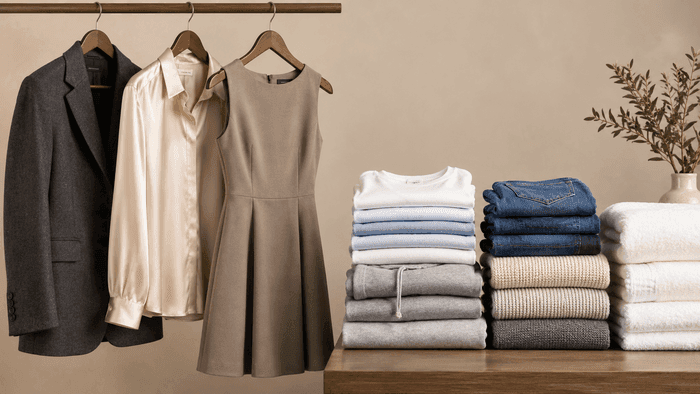
People treat the care label as a legal document. It is closer to a manufacturer’s insurance policy: the most conservative instruction that cannot possibly go wrong, printed once for an entire production run. Sometimes it is right. Sometimes it says dry clean only on a cotton shirt because one panel has a rayon trim.
Knowing what each process actually does makes the decision obvious most of the time.
What the two processes actually are
Dry cleaning is not dry. It is washing in a solvent instead of water. The point is that solvent dissolves oil and grease without swelling the fibers, so wool keeps its structure, silk keeps its hand, and nothing shrinks or loses its shape. What solvent is poor at is water-based soil: sweat, salt, sugar, and mud all come out better in water. That is why a good cleaner pre-treats those areas by hand before the garment goes anywhere near the machine.
Wash and fold is laundering in water with detergent, then drying and folding. Water is excellent at everything solvent is bad at, and it is gentler on cotton and linen than most people assume. Its risks are the ones everyone knows: shrinkage, dye bleeding, felting on wool, and distortion of anything with structure.
Water is better at sweat and salt. Solvent is better at oil and grease. Almost every decision follows from that one sentence.
Send it to dry cleaning
- Anything tailored or structured. Suits, blazers, sport coats, and structured dresses have interlinings, canvas, and shoulder construction that are assembled with the assumption they will never get soaked. Water separates those layers and they never sit flat again.
- Wool, cashmere, and fine animal fibers. Water plus agitation plus heat is the recipe for felting, and felting is irreversible. Wool trousers, coats, and suiting all belong here.
- Silk, chiffon, velvet, satin, and lace. Waterspotting, dye migration, and crushed pile are all real and all permanent.
- Anything beaded, sequined, or embroidered. Agitation in water pulls threads and beading loose.
- Pleated garments. Set pleats are heat-set; water relaxes them and they will not come back.
- Anything with an oil or grease stain, whatever it is made of. Water will fix the stain in place while cleaning around it.
- Lined garments, where the lining and the shell will shrink at different rates and pucker.
Send it to wash and fold
- Cotton and linen basics. T-shirts, jeans, chinos, sweatpants, pajamas, underwear, and socks.
- Anything worn against the skin all day. Sweat is water-based; water is what removes it. Gym clothes in particular need laundering, not dry cleaning, and the smell that survives a wash is usually bacteria in synthetic fibers rather than dirt.
- Towels, sheets, and everyday bed linen.
- Children’s clothing, where the soil is food and playground and the volume is relentless.
- Most modern synthetics without structure, which are designed for the machine.
The genuinely ambiguous cases
Dress shirts
These are laundered, not dry cleaned — cotton releases body soil far better in water — but they are finished and pressed the way a dry-cleaned garment is, with the collar, cuffs, yoke, and placket shaped individually. That combination is its own service and it is the reason shirts from a cleaner look different from shirts out of a home dryer.
Cashmere sweaters
Both are defensible. Dry cleaning is safer and keeps the hand; careful hand-washing in cool water is gentler on the fiber over many cycles but is unforgiving of a single mistake. The compromise most people should make is to wear cashmere over something else, clean it two or three times a season, and let a cleaner handle it.
Down coats and comforters
Water, generally — down needs to be washed and then properly dried to redistribute the fill. The difficulty is drying, not washing, and it is not a job for an apartment dryer. Bring it in.
Anything labelled “dry clean only” that is plainly cotton
Often the label is protecting a trim, an unstable dye, or a fused interfacing rather than the main fabric. Show it to us and we will tell you which. We are not going to pretend a cotton shirt needs solvent.
The mistakes we see most
- Dry cleaning gym clothes and then wondering why they still smell. Solvent does not remove sweat.
- Machine-washing wool trousers once and losing two inches of leg permanently.
- Washing a garment with an oil stain, which sets it, and then bringing it for dry cleaning afterward, by which point the stain is much harder.
- Hanging heavy knitwear, which stretches the shoulders whatever it has been cleaned in.
When you cannot decide
Bring it in and ask. It costs nothing and takes a minute, and we would rather look at a garment than have you guess. If it belongs in wash and fold we will say so, even though dry cleaning costs more — a customer who trusts what we tell them is worth considerably more to a neighborhood shop than one over-charged jacket.