
What to do about a stain before you reach the cleaners
The first sixty seconds decide whether a stain comes out. What to do at the table, what to never do, and why club soda and a hotel hair dryer have ruined more clothes than red wine ever has.
· 8 min · Milton Cleaners
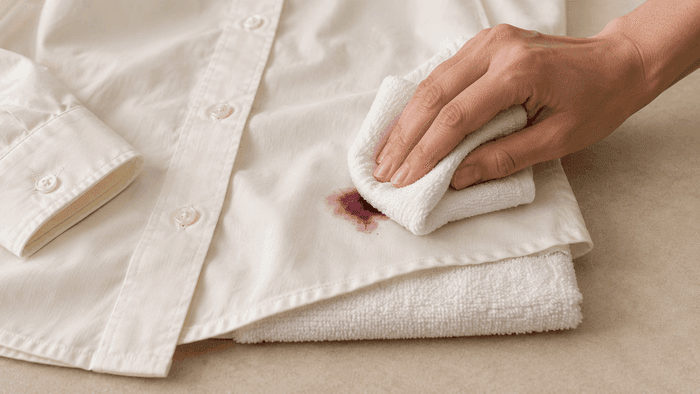
Almost every stain that ends up permanent was removable when it landed. What made it permanent was something done in the first minute — usually with a napkin, sometimes with a hotel hair dryer, occasionally with a bottle of club soda that someone at the table swore by.
Here is what actually helps, what actively hurts, and why.
The three rules that cover almost everything
- Blot, never rub. Press a clean white cloth or napkin straight down onto the stain and lift. Rubbing drives the stain deeper into the weave, spreads it wider, and abrades the fiber surface so the area stays dull even after the color comes out.
- Work from the outside in. If you must dab, start at the edge of the mark and move toward the middle. Working outward pushes the boundary of the stain wider, and the ring is often harder to remove than the center.
- Keep heat away from it. No hot water, no hair dryer, no radiator, and above all no iron. Heat sets protein and sugar stains permanently by cooking them into the fiber. A stain that is still wet is a stain we can still work with.
What to do at the table
Blot up whatever is sitting on the surface. If the garment is washable and you are somewhere with a tap, hold the back of the fabric under cool running water so the stain is pushed back out the way it came in rather than further through. Then stop. Leave it alone, get it to us as soon as you reasonably can, and tell us exactly what it was.
That last part matters more than anything else you can do. The chemistry for removing red wine is not the chemistry for removing olive oil, and if we know what caused a mark we can choose correctly the first time instead of testing our way toward it.
The home remedies that cause the damage
- Club soda. It does nothing the water in it would not do, and on silk, wool, and anything with an unstable dye it leaves a waterspot ring that is more visible than the original stain.
- Salt on red wine. Salt draws some liquid out, then bonds with the tannin and makes the residue harder to lift. It also abrades the fabric while you are grinding it in.
- White wine on red wine. Now there are two stains.
- Hand soap, dish soap, or a stain pen in a restaurant bathroom. These leave a detergent ring, and on dyed fabrics they frequently lift the color along with the stain. The bleached patch is permanent in a way the wine was not.
- The hand dryer or a hair dryer. The fastest way to set a stain permanently. Whatever you do, do not dry it.
We can almost always do something with a wet stain. A stain that has been rubbed, soaped, and blow-dried has usually made its own decision.
Specific stains, and what they need
Red wine, coffee, tea, fruit juice
These are tannin stains. Blot, flush with cool water from the back if you can, and bring it in. Do not use soap — soap sets tannin. Do not use hot water.
Oil, butter, salad dressing, makeup
Water will not touch these; they need solvent, which is what dry cleaning is. Blot up what is sitting on top. If you are desperate and the garment is not delicate, a little cornstarch or talc left to absorb for twenty minutes and then brushed off will pull some oil out. Nothing else at home will help.
Blood, egg, dairy, perspiration
Protein stains, and the heat rule matters most here. Cold water only. Warm or hot water coagulates protein into the fiber and the stain is then effectively part of the fabric.
Ink
Blot, do not rub, and resist the widely repeated hairspray trick — modern hairsprays are mostly polymer rather than alcohol and you will add a sticky ring around a stain that is still there. Ballpoint ink on a shirt is usually removable; felt tip and gel are much harder. Bring it in quickly.
Champagne, white wine, and clear soda
The dangerous one, because there is nothing to see. Sugar dries colorless and oxidizes to brown over the following months, which is how a dress put away looking perfect comes out of the closet with marks nobody remembers making. If something clear was spilled on a garment you care about, tell us — we will treat the area even though there is nothing visible.
Deodorant and antiperspirant
The white marks are usually removable. The yellow-and-stiff underarm damage on shirts is a reaction between aluminium salts and body oils that has bonded to the cotton, and it is frequently permanent. Prevention is the whole answer: let deodorant dry fully before dressing, and launder shirts after every wear.
When to stop and just bring it in
Bring it straight to us, untouched beyond blotting, if the garment is silk, wool, cashmere, velvet, leather, suede, beaded, embroidered, brightly dyed, vintage, or expensive enough that you would be upset to lose it. On those fabrics the risk of a home remedy is not that it fails; it is that it causes a second, worse problem in the shape of a ring, a bleached patch, or a crushed nap.
And do not let embarrassment delay you. We have seen it. Every stain we are given quickly and honestly described is a stain we have a real chance with — and the ones we cannot fix, we will tell you about before you pay.